SELECTED WORK — CASE STUDY
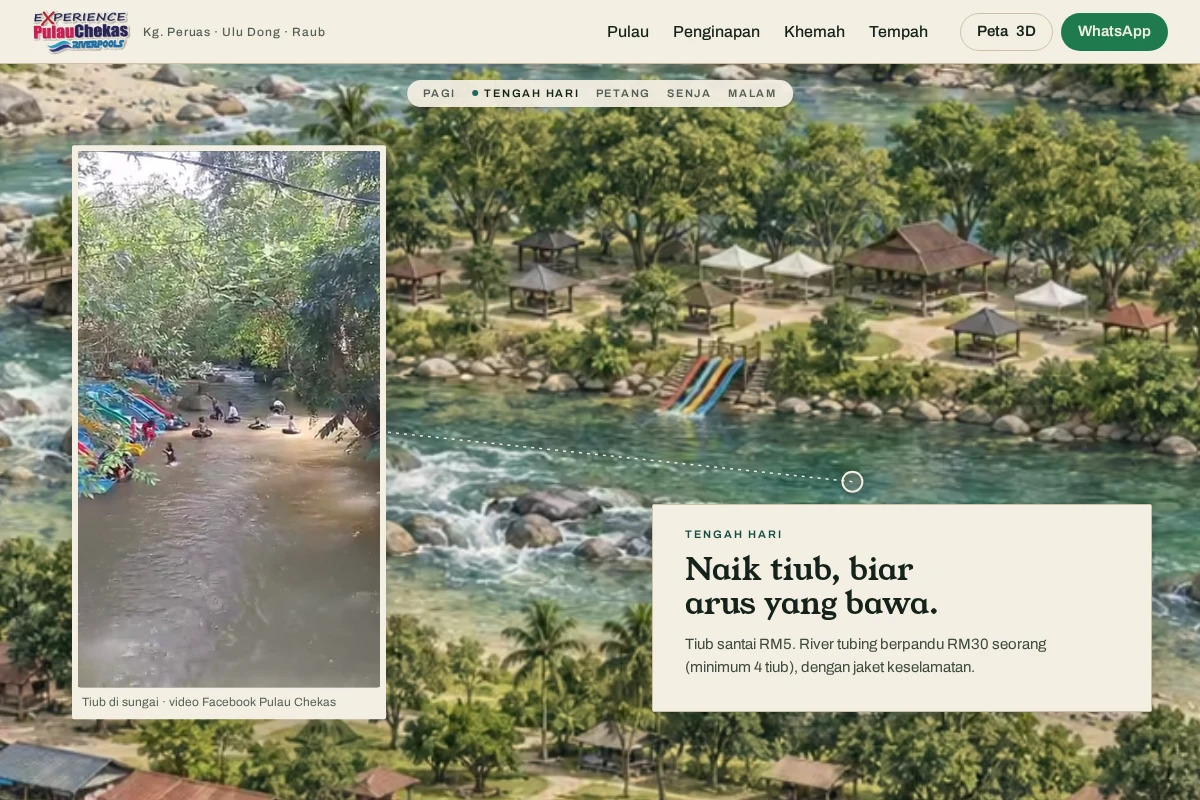
A riverside park website with a booking system in Malaysia — Pulau Chekas
The business
Pulau Chekas Riverpool is a riverside recreation park in Kg. Peruas, Ulu Dong, near Raub in Pahang. Sungai Dong, Sungai Peruas and Sungai Chemerkau meet there around a small island. Day visitors picnic in numbered gazebos on the island, swim, slide into the river, go tubing or take a kayak. Nine chalets and three homestays sit on the banks around it, and there are campsites by the water.
The problem
A list of units and prices does not show what a day there is like, or how the island, the bridges and the places to sleep fit together.
Bookings were the other half. Requests came in through the website, WhatsApp and the telephone, and the team needed them in one place without a website form pretending to confirm a stay.
What I built
I rebuilt the site around a painting of the confluence, laid out from the owner's own map. It is the first thing you see. Unit codes, prices and times are set as text over the painting, never painted into it. The sky follows the real time and weather in Raub, and the page says where that comes from.
Scrolling moves through one day on the island, from morning mist to night. Each stop opens the park's own photos or video from the spot where they were taken, captioned as theirs, with entry fees and activity prices beside them: tubing, kayaks, ATV rides, the forest trail. At dusk the story visits each chalet and homestay in turn, with the owner's photos, its code and its rate, or a note to ask. A skip button jumps straight to the listings for anyone who only wants to book.
Below the story sit the practical sections: day-visit prices on the island, a map of the chalets and homestays, the campsites, nearby shops, food stalls, weekly markets and the shuttle from the train stations. The interactive 3D map from the earlier build is still there. It opens in a new tab from a button on every screen instead of loading with the page.
There are three booking forms: chalet or homestay, campsite, and a gazebo for a day visit. Sending one records the request in Buku Lejar, the team's booking-management app, and then opens WhatsApp with the message already written. If the app cannot be reached, the message is marked so staff enter it by hand.
Buku Lejar also holds the bookings staff take on WhatsApp or by phone. Staff track booking status and deposits, admin and operator access are separate, and the app records who changed what and when.
What it does for the business
A visitor can see the place before deciding: where the island is, what a day there holds, which unit sits where, and what it costs. When they send a form, the request is recorded in the team's ledger and opens in their WhatsApp at the same time, so staff do not have to copy it from a chat.
The site takes no payment. Staff confirm dates and the deposit on WhatsApp, and a form request is not presented as a confirmed booking.
Stack & notes
Website design and development, the scroll story, the interactive 3D map and the booking-management app. Units are listed by code. The screenshot on this page was taken from the live site on 26 November 2026. The site's sky follows the visitor's clock and the live weather, so the home page card shows it as it looked at 1 pm that day, replayed with Open-Meteo's reading for that hour. The booking-interface example was rendered locally from application templates using clearly labelled sample records, not live customer data.